


Executive Summary (Quick Answer): In late 2026, the open-source agent ecosystem has reached a decisive architectural fork. As tracked on the Reposen AI & Agent Radar, teams building production agentic applications are no longer picking generic LLM wrappers, but choosing between two fundamentally distinct runtime philosophies. The TypeScript path, spearheaded by mastra-ai/mastra with its newly shippedv0.50.0milestone, prioritizes full-stack reactivity, graph-based workflow state machines, native Model Context Protocol (MCP) tooling, and instant Next.js generative UI bindings. Conversely, the Python path, led by pydantic/pydantic-ai (v2.68.0), treats agents as type-safe, dependency-injected backend microservices tightly coupled to the scientific Python ecosystem and existing FastAPI backends.
For the first eighteen months of the generative AI boom, Python enjoyed a virtual monopoly on agent frameworks. Libraries like LangChain, AutoGen, and CrewAI established early patterns for chaining prompts and routing tools. Yet in production environments, teams repeatedly ran into familiar operational friction: untyped dictionaries leaking through multi-step agent steps, difficult serialization across client-server boundaries, and awkward friction when connecting agent states to real-time React web applications.
Over the past quarter, release telemetry tracked across Reposen reveals a massive surge in TypeScript agent infrastructure. With the release of @mastra/core v0.50.0 (tracked on November 12, 2026) alongside rapid adoption of @copilotkit/react-core@1.87.1 and @ai-sdk/zai@3.0.53, TypeScript is no longer just a consumer of Python backend APIs, but a primary host for autonomous agents.
At the exact same time, the Python ecosystem responded with its strongest architectural evolution to date: Pydantic AI. By bringing FastAPI-style dependency injection and compile-time type validation to model execution, Pydantic AI discarded legacy prompt-string hacks in favor of strict typed contracts.
Here is an in-depth architectural breakdown of how these two leading frameworks compare, where each shines in production, and how to choose the right foundation for your team.
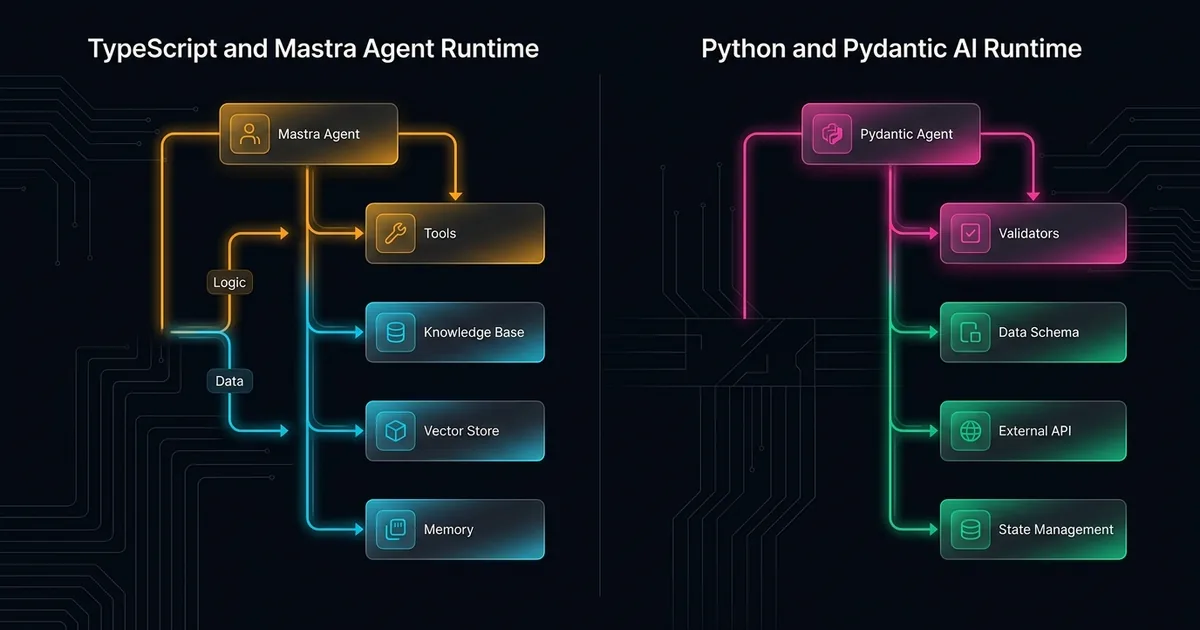
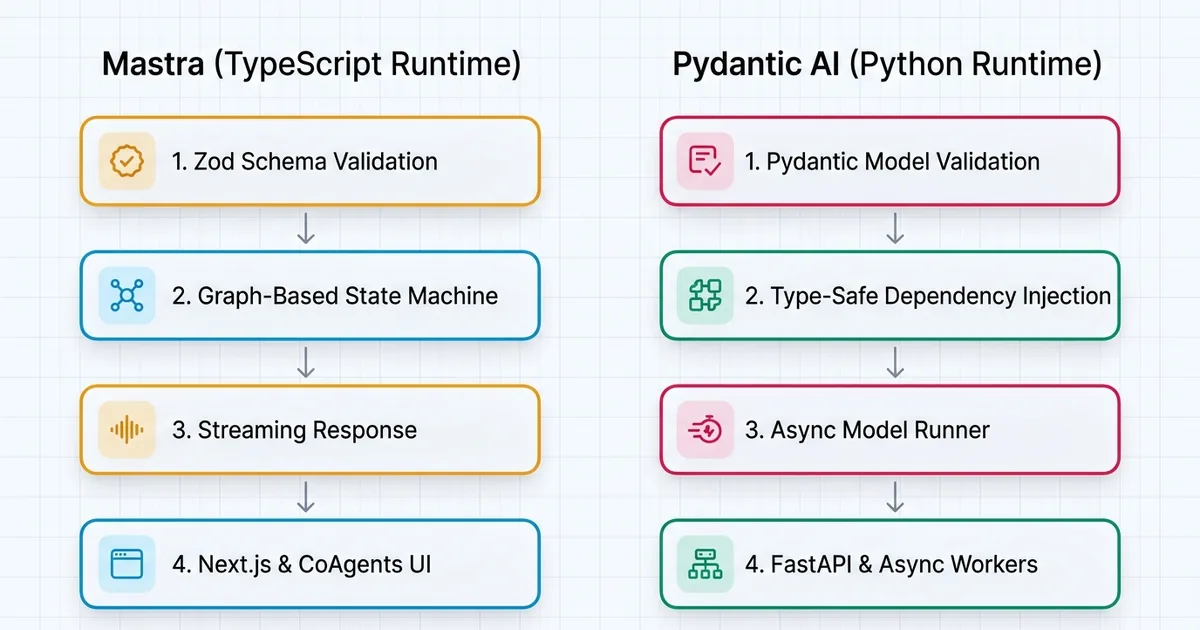
Figure 1: Architectural comparison showing Mastra's reactive state-machine pipeline (left) versus Pydantic AI's type-validated dependency injection workflow (right).
Paradigm 1: Mastra AI and the Full-Stack TypeScript Ecosystem
Mastra approaches AI agents not as isolated mathematical scripts, but as durable backend applications that live alongside the modern web stack. Built natively in TypeScript, Mastra consolidates workflows, agents, RAG pipelines, evals, and local dev tooling into a cohesive framework.
1. Graph-Based Workflows as Deterministic State Machines
The signature breakthrough of Mastra v0.50.0 is its refined workflow engine. While early agent frameworks allowed LLMs to loop unpredictably until context windows overflowed, Mastra treats complex agent behavior as a directed acyclic graph (DAG) or cyclic state machine with deterministic transitions.
Each step in a Mastra workflow defines explicit Zod input and output schemas. If an agent step produces malformed JSON, the step fails at the schema boundary before corrupting downstream operations. Furthermore, workflow steps support suspended execution, human-in-the-loop approvals, and resume triggers out of the box.
import { createWorkflow, Step } from "@mastra/core/workflows";import { z } from "zod";
const auditTelemetryStep = new Step({ id: "audit-telemetry", inputSchema: z.object({ repoOwner: z.string(), repoName: z.string(), }), outputSchema: z.object({ breakingChangesCount: z.number(), securityPatches: z.array(z.string()), recommendation: z.enum(["proceed", "hold", "manual_review"]), }), execute: async ({ context }) => { const { repoOwner, repoName } = context; // Inspect repository releases via Reposen API or MCP tool const response = await fetch(`https://reposen.se/api/repo/${repoOwner}/${repoName}`); const data = await response.json();
return { breakingChangesCount: data.breakingCount ?? 0, securityPatches: data.securityAlerts ?? [], recommendation: data.breakingCount > 0 ? "manual_review" : "proceed", }; },});
const notifyTeamStep = new Step({ id: "notify-team", inputSchema: z.object({ breakingChangesCount: z.number(), securityPatches: z.array(z.string()), recommendation: z.enum(["proceed", "hold", "manual_review"]), }), outputSchema: z.object({ notified: z.boolean(), }), execute: async ({ context }) => { const { recommendation } = context; // Dispatch instant alert or trigger human-in-the-loop approval if flagged for review return { notified: true }; },});
export const releaseGuardWorkflow = createWorkflow({ name: "release-guard", triggerSchema: z.object({ repoOwner: z.string(), repoName: z.string(), }),}) .step(auditTelemetryStep) .then(notifyTeamStep) .commit();
// Trigger workflow execution with strict schema validationconst { runId, start } = releaseGuardWorkflow.createRun();await start({ triggerData: { repoOwner: "mastra-ai", repoName: "mastra" },});2. First-Class Model Context Protocol (MCP) Integration
As detailed in our previous analysis of the Production MCP Stack, standardizing tool definitions is mandatory for scalable agents. Mastra provides native client and server MCP adapters, allowing developers to consume any standard MCP server (such as GitHub, Neon, Slack, or filesystem servers) with zero manual bridging code.
3. Direct Streaming to React and Next.js (Generative UI)
Because Mastra runs on the Node.js or Bun runtime, it shares type definitions directly with frontend frameworks. When paired with Vercel AI SDK and CopilotKit, an agent in Mastra can stream incremental tokens, intermediate tool executions, and interactive Generative UI components straight to the browser over standard Server-Sent Events (SSE).
Paradigm 2: Pydantic AI and Typed Python Infrastructure
While TypeScript excels at full-stack integration, Python remains the undisputed hub for deep learning, scientific computing, and model fine-tuning. For teams whose infrastructure already centers around PyTorch, Hugging Face, Pandas, or FastAPI, rewriting backends into TypeScript is often impractical.
This is where Pydantic AI (v2.68.0) represents a quantum leap forward. Built by the creators of Pydantic, the foundational validation library powering FastAPI and OpenAI's official Python SDK, Pydantic AI brings uncompromising type safety to Python agent development.
1. Model-Agnostic Dependency Injection via RunContext
In traditional Python agent libraries, injecting database connections, user session tokens, or API clients into an agent prompt required awkward global singletons or custom wrapper classes. Pydantic AI solves this using a type-safe dependency injection system inspired directly by FastAPI:
from dataclasses import dataclassimport httpxfrom pydantic import BaseModel, Fieldfrom pydantic_ai import Agent, RunContext
@dataclassclass AgentDependencies: reposen_api_key: str http_client: httpx.AsyncClient
class ReleaseImpactResult(BaseModel): package_name: str risk_score: float = Field(ge=0.0, le=1.0) summary: str requires_staging_test: bool
radar_agent = Agent( model="anthropic:claude-3-7-sonnet", deps_type=AgentDependencies, result_type=ReleaseImpactResult, system_prompt="You are a senior release safety engineer auditing open-source package updates.",)
@radar_agent.toolasync def query_cortex_telemetry( ctx: RunContext[AgentDependencies], package_name: str) -> dict: """Fetch live release telemetry from Reposen Sense Engine.""" headers = {"Authorization": f"Bearer {ctx.deps.reposen_api_key}"} response = await ctx.deps.http_client.get( f"https://reposen.se/api/repo/{package_name}", headers=headers, ) return response.json()
# Execute agent with strongly typed dependenciesasync def run_audit(): async with httpx.AsyncClient(timeout=10.0) as client: deps = AgentDependencies( reposen_api_key="rep_live_sample_token", http_client=client ) result = await radar_agent.run( "Analyze breaking risk for @mastra/core v0.50.0", deps=deps ) # result.data is guaranteed to be a validated ReleaseImpactResult print(f"Risk Score: {result.data.risk_score}") print(f"Summary: {result.data.summary}")2. Type-Driven Structured Output Guarantees
In Pydantic AI, setting result_type=ReleaseImpactResult guarantees that the agent's final return value is an actual, validated instance of ReleaseImpactResult. If the underlying LLM omits a required field or outputs an invalid score, Pydantic AI automatically catches the validation error, feeds the validation traceback back to the model as an error correction turn, and prompts the model to self-heal its output.
3. Native Harmony With the Python Data Ecosystem
When your agent needs to run local embedding models, query vector databases via FAISS or Chroma, compute matrix transformations with NumPy, or train custom evaluation classifiers, Pydantic AI runs in the same Python process without serialization overhead or cross-language IPC penalties.
Comprehensive Comparison: Mastra vs Pydantic AI in Production
To evaluate how both stacks perform across key engineering metrics, our team reviewed real-world telemetry from the Reposen Sense Engine and production deployment patterns across our tracked repositories:
| Architectural Vector | Mastra AI (TypeScript) | Pydantic AI (Python) | Production Significance |
|---|---|---|---|
| Primary Language | TypeScript (Node.js, Bun) | Python (>= 3.10) | Determines developer ergonomics and team staffing |
| Schema Validation | Zod / Standard Schema | Pydantic v2 (Rust-backed core) | Pydantic v2 offers faster serialization in heavy loops |
| Workflow State Machine | Graph-based DAG with suspend/resume | Agent loop with manual step composition | Mastra excels at complex, multi-stage business logic |
| Frontend Cohesion | Native SSE, React hooks, CopilotKit | Requires FastAPI / WebSocket bridge | TypeScript eliminates dual-schema sync between backend and UI |
| Model Context Protocol | Native MCP client and server modules | Community adapters, custom tool bridges | Mastra has deeper out-of-the-box MCP integration |
| Memory & Storage | Built-in LibSQL, PgVector, Pinecone | Plug-and-play via Python database drivers | Mastra includes built-in conversation persistence tables |
| Deployment Footprint | Lightweight serverless or Docker; 50-100ms cold starts on Edge and Node.js | Docker containers or FastAPI/Celery workers; 500ms-1.5s cold starts with scientific wheels | Critical differentiator for interactive web latency vs asynchronous batch queues |
| Model Agnosticism | Unified provider registry via AI SDK | Model-agnostic interface across OpenAI, Anthropic, Gemini | Both frameworks cleanly decouple business logic from LLM APIs |
The Architectural Decision Rubric: Which Should You Choose?
Neither framework is universally superior; the optimal choice depends entirely on your existing system topology, data requirements, and user experience goals:
Choose Mastra AI If:
- You are building an end-user application with Generative UI: If your agent directly manipulates web UI state, streams cards into a Next.js chat pane, or collaborates with users in real-time via CopilotKit, Mastra eliminates the friction of maintaining duplicated TypeScript and Pydantic schemas.
- Your team is composed primarily of full-stack engineers: Teams with strong TypeScript, React, and Node.js expertise can author agents, backend workflows, and frontend components in a single unified language.
- Your workflows require durable human-in-the-loop checkpoints: Mastra's state machine engine natively supports pausing execution, persisting state to PostgreSQL or SQLite, and resuming when an admin approves an action.
Choose Pydantic AI If:
- Your core platform is already built on Python and FastAPI: If your backend services, database models, and existing API layers are powered by Pydantic and SQLAlchemy, Pydantic AI integrates seamlessly without introducing a separate Node runtime.
- Your agent interacts with scientific computing or ML pipelines: If tool execution requires NumPy, Pandas, PyTorch, Hugging Face transformers, or specialized data science algorithms, staying in Python avoids expensive inter-process serialization.
- You prioritize maximum backend validation rigor: Pydantic's Rust-based validation core provides unmatched speed and type checking guarantees for high-volume enterprise ingestion pipelines.
The Emerging Hybrid Architecture: TypeScript at the Edge, Python in the Core
In high-scale enterprise architectures, engineering teams are increasingly moving away from pure language dogmatism. Instead of forcing an either-or decision, production systems routinely deploy a pragmatic hybrid topology:
- Edge and Presentation Layer (Mastra / Next.js / Vercel AI SDK): Runs in TypeScript on Vercel or lightweight Node.js runtimes. It handles user authentication, websocket subscriptions, stream parsing, and Generative UI widgets directly in React.
- Heavy Compute and Data Science Core (Pydantic AI / FastAPI): Runs in Python in persistent Docker containers. It orchestrates vector search, local embedding pipelines, fine-tuned transformer inference, and database migrations.
- The Universal Protocol Bridge (Model Context Protocol): Both systems interact through standardized MCP servers and OpenAPI schemas. The Mastra agent can invoke Pydantic AI microservices as standard tools, preserving type safety on both sides of the language divide.
Practical Implementation Checklist for Engineering Teams
Before rolling out either agent framework into staging or production, enforce these essential operational guards:
- Enforce Strict Schema Contracts on Tool Boundaries: Never pass raw, untyped strings to model tools. Use Zod schemas in Mastra or Pydantic models in Pydantic AI to ensure parameter validation occurs before any database mutation.
- Isolate Agent Permissions With Scoped Credentials: When agents invoke external tools or APIs, use short-lived scoped tokens or OIDC session tags rather than granting full administrative credentials to the agent runner.
- Monitor Live Release Feeds for Breaking Changes: As demonstrated by the recent
v0.50.0milestone in Mastra and rapid patch releases across the AI SDK ecosystem, AI frameworks evolve quickly. Subscribe to the Reposen AI & Agent Radar to receive real-time alerts when dependencies introduce breaking changes. - Implement Deterministic Evaluation Gates: Never push prompt or model changes to production without running regression evals. Mastra includes built-in eval metrics, while Pydantic AI agents can be tested deterministically using pytest and mocked model outputs.
Frequently Asked Questions (FAQ)
Can Mastra AI and Pydantic AI work together in the same architecture?
Yes, in many enterprise architectures, teams deploy Pydantic AI as an internal microservice running alongside Python data science workloads, while using Mastra or Next.js on the frontend edge to handle user interaction, generative UI streaming, and MCP orchestration.
How does Mastra v0.50 differ from earlier versions?
Mastra v0.50.0 introduces a completely overhauled graph-based workflow engine with suspend-and-resume capabilities, deeper Model Context Protocol (MCP) server support, unified memory persistence, and enhanced evaluation hooks for measuring agent accuracy before deployment.
Is Pydantic AI suitable for high-throughput production workloads?
Yes, because Pydantic AI is powered by Pydantic v2's compiled Rust validation core, its serialization and validation overhead is among the lowest in the Python ecosystem, making it well-suited for high-concurrency FastAPI microservices.
Where can I track daily releases and compatibility for AI agent frameworks?
You can follow live GitHub release streams, breaking-change telemetry, and synthesized engineering briefs for Mastra, Pydantic AI, CopilotKit, and over 200 curated open-source repositories on the Reposen AI Radar and the Daily Cortex Archive.