
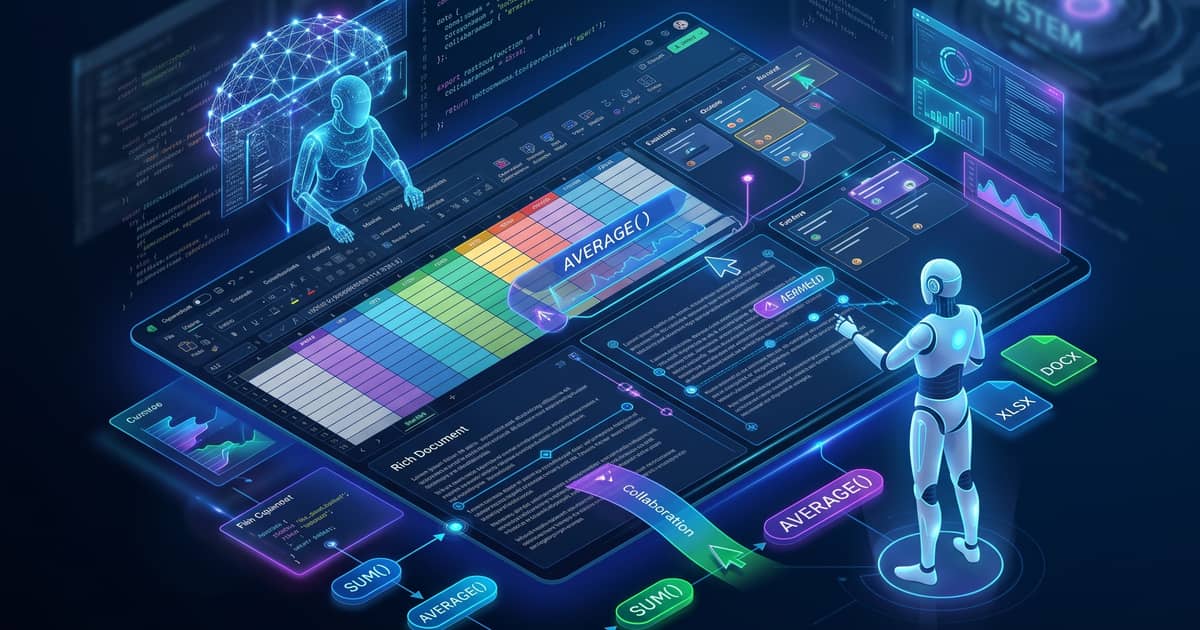
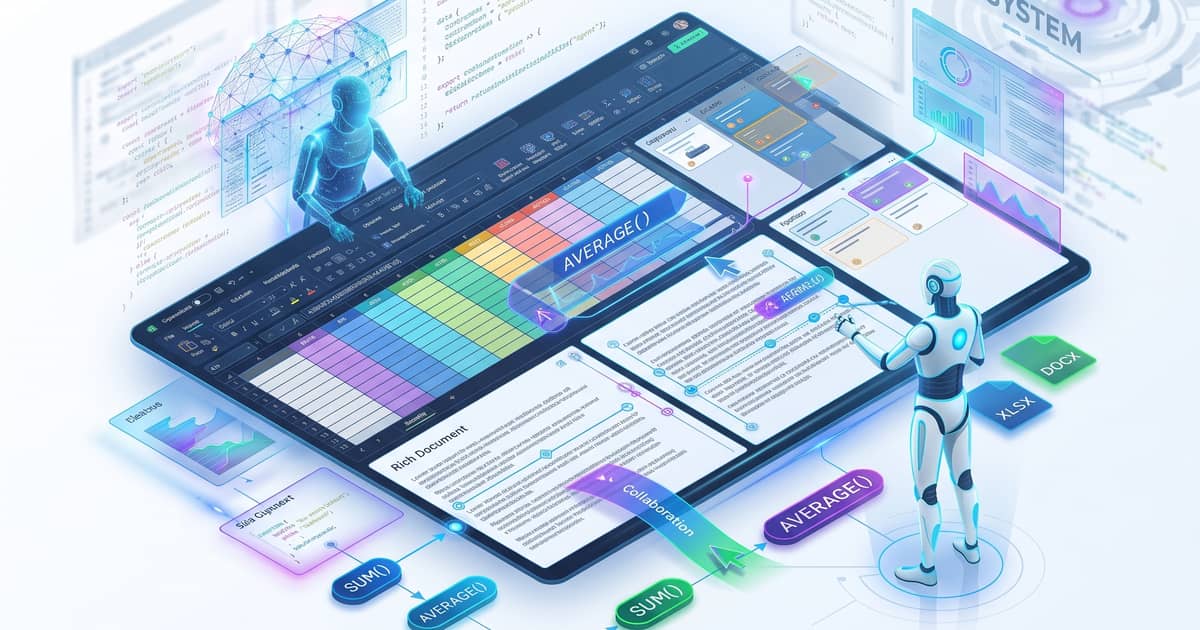
Executive Summary (Quick Answer): Univer is a full-stack, open-source office SDK designed to embed spreadsheets, collaborative documents, and presentation slides into web applications without the performance degradation of DOM-based editors. By replacing contenteditable and heavy HTML tables with an optimized HTML5 Canvas Rendering Engine, Univer achieves sustained 60fps scrolling across million-cell grids. Built on an enterprise-grade Dependency Injection (DI) architecture and a deterministic Command-Mutation state machine, Univer enables autonomous AI agents like LangChain to programmatically read, manipulate, and generate complex office data structures headlessly without simulated browser clicks.Integrating full-featured spreadsheets, formatted documents, or slide decks into production web applications has historically represented one of the most notoriously brittle engineering challenges in frontend development. Teams attempting to build rich document editing with native browser contenteditable routinely encounter inconsistent cross-browser behavior, caret jumping, and corrupted clipboard serialization. Simultaneously, data-heavy grid implementations relying on standard DOM elements (<table> or virtualized <div> structures) collapse under the memory pressure of tens of thousands of simultaneous layout recalculations.
Enter Univer, an innovative open-source office SDK developed by DreamNum. Designed specifically for contemporary web architectures and the expanding AI agent ecosystem, Univer reimagines the office suite as a modular, framework-agnostic client framework.
In this deep architectural analysis, we dissect why Univer chose Canvas over the DOM, examine its client-side Dependency Injection container, evaluate its headless mutation engine for AI agent automation, and benchmark its product strategy against traditional commercial SDKs.
1. The Architectural Shift: Why Canvas Over DOM?
When evaluating frontend grid architectures, rendering strategies fall into two distinct paradigms: DOM virtualization and direct Canvas painting.
In DOM virtualization, elements outside the active viewport are unmounted, and visible cells are dynamically repositioned during scroll events. While viable for basic data tables, this approach hits hard architectural limits when implementing full spreadsheet functionality:
- Layout Thrashing and Style Recalculation: Editing a cell formula that cascades across multiple dependent ranges triggers widespread DOM modifications, forcing the browser layout engine into costly recalculation loops.
- Text Measurement Inconsistencies: Across Chrome, Safari, and Firefox, slight discrepancies in font kerning, subpixel font rendering, and box-sizing cause cell overflows and visual jitter.
- Complex Cell Decorators: Rendering multi-line text, conditional formatting heatmaps, data validation badges, sparklines, and cell comments simultaneously generates deep DOM trees that overwhelm mobile and lower-spec client hardware.
Univer circumvents these limitations entirely by adopting a Canvas-based rendering pipeline, echoing the architectural blueprint used internally by Google Sheets.
By painting text, borders, cell backgrounds, and selection handles directly onto an HTML5 Canvas context, Univer decouples spreadsheet rendering from the browser layout engine. Grid cells exist purely as numerical coordinates in a spatial index, enabling butter-smooth 60fps scrolling, instant zooming, and mathematically exact pixel parity across all browsers and operating platforms.
2. Plugin Architecture and Client-Side Dependency Injection
For software architects, integrating an office SDK often introduces significant bundle weight risks. A monolithic office suite weighing 3MB to 5MB degrades initial page load performance, compromising Core Web Vitals (specifically Largest Contentful Paint).
To solve this, Univer is architected around an extensible Dependency Injection (DI) container, providing a modular topology reminiscent of backend frameworks like NestJS, yet specifically calibrated for lightweight client-side execution.
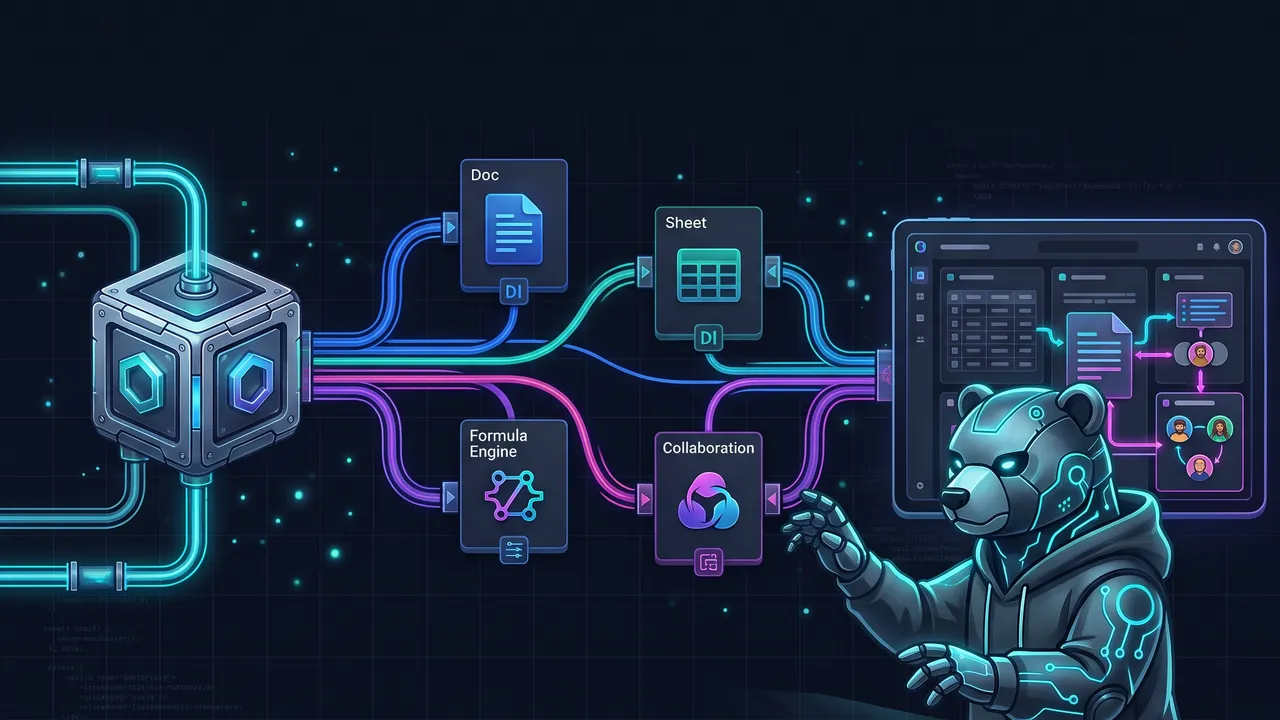
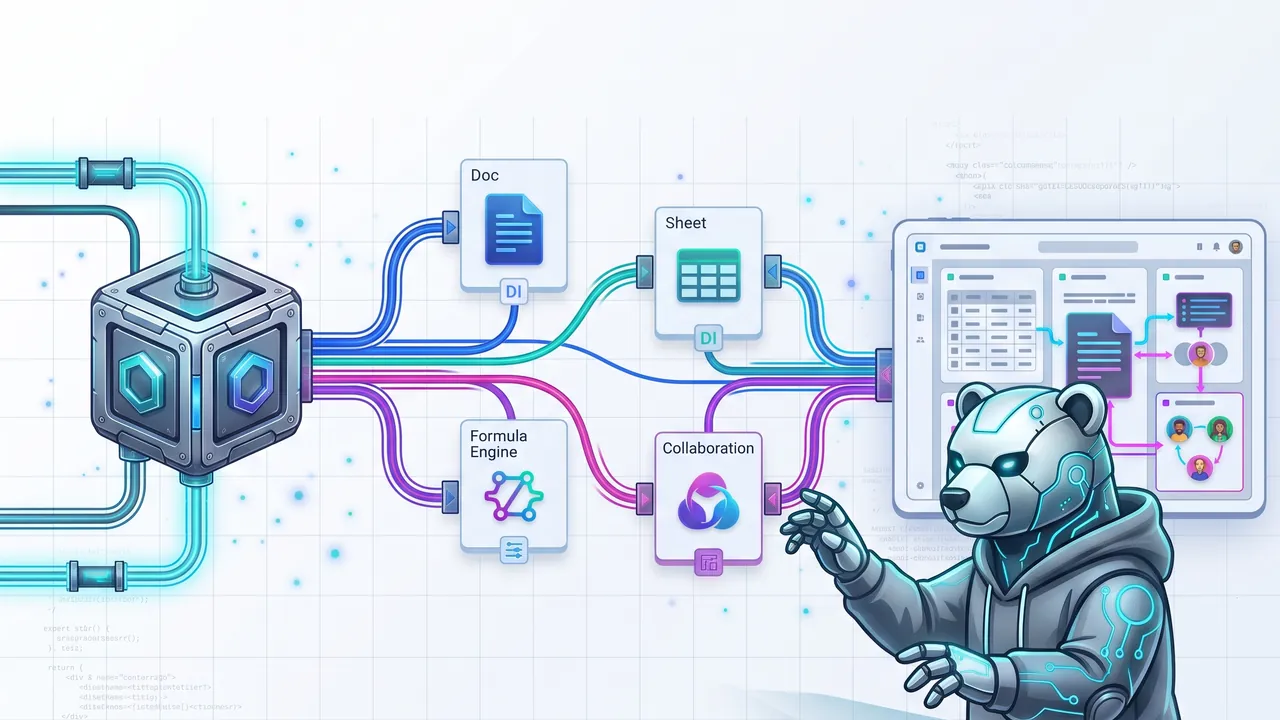
Figure 1: Modular plugin orchestration in Univer, injecting isolated domain engines (Docs, Sheets, Formula Engine, Collaboration) on top of a lightweight Dependency Injection container.
In Univer's topology, the core runtime (@univerjs/core) acts solely as a microkernel. It establishes the event loop, command bus, selection registry, and DI lifecycle. Every high-level capability, including spreadsheet calculations, document editing, and formula evaluation, is implemented as a standalone plugin:
// services/office/univer_bootstrap.tsimport { Univer } from "@univerjs/core";import { UniverDocsPlugin } from "@univerjs/docs";import { UniverSheetsPlugin } from "@univerjs/sheets";import { UniverFormulaEnginePlugin } from "@univerjs/engine-formula";import { UniverRenderEnginePlugin } from "@univerjs/engine-render";
// 1. Initialize the lightweight microkernel containerconst univer = new Univer();
// 2. Register hardware-accelerated canvas rendering engineuniver.registerPlugin(UniverRenderEnginePlugin);
// 3. Register only required business domain pluginsuniver.registerPlugin(UniverDocsPlugin);univer.registerPlugin(UniverSheetsPlugin);univer.registerPlugin(UniverFormulaEnginePlugin);This strict decoupling yields three major engineering advantages:
- Granular Bundle Optimization: Applications that only require formula parsing on the backend can import
@univerjs/engine-formulawithout pulling in UI rendering dependencies. - Framework Independence: Core document logic is authored in pure TypeScript, allowing developers to create wrappers for React, Vue, or vanilla web components without framework lock-in.
- Isomorphic Execution: Because the data and formula engines are decoupled from canvas drawing routines, they can run headlessly inside Node.js or edge workers to evaluate formulas, validate inputs, or generate reports asynchronously.
3. The AI Agent Ecosystem: Headless Mutation-Driven Automation
The primary catalyst driving Univer's rapid adoption across the developer community is its native compatibility with autonomous AI agents.
Traditional web applications rely on accessibility trees, DOM queries, or simulated click events (such as Playwright or Puppeteer) to automate user interactions. However, simulating clicks across an office interface is notoriously error-prone, requiring visual grounding models to estimate bounding boxes for tiny cell coordinates.
Univer bypasses visual simulation entirely by implementing an immutable, event-sourced Command-Mutation architecture.

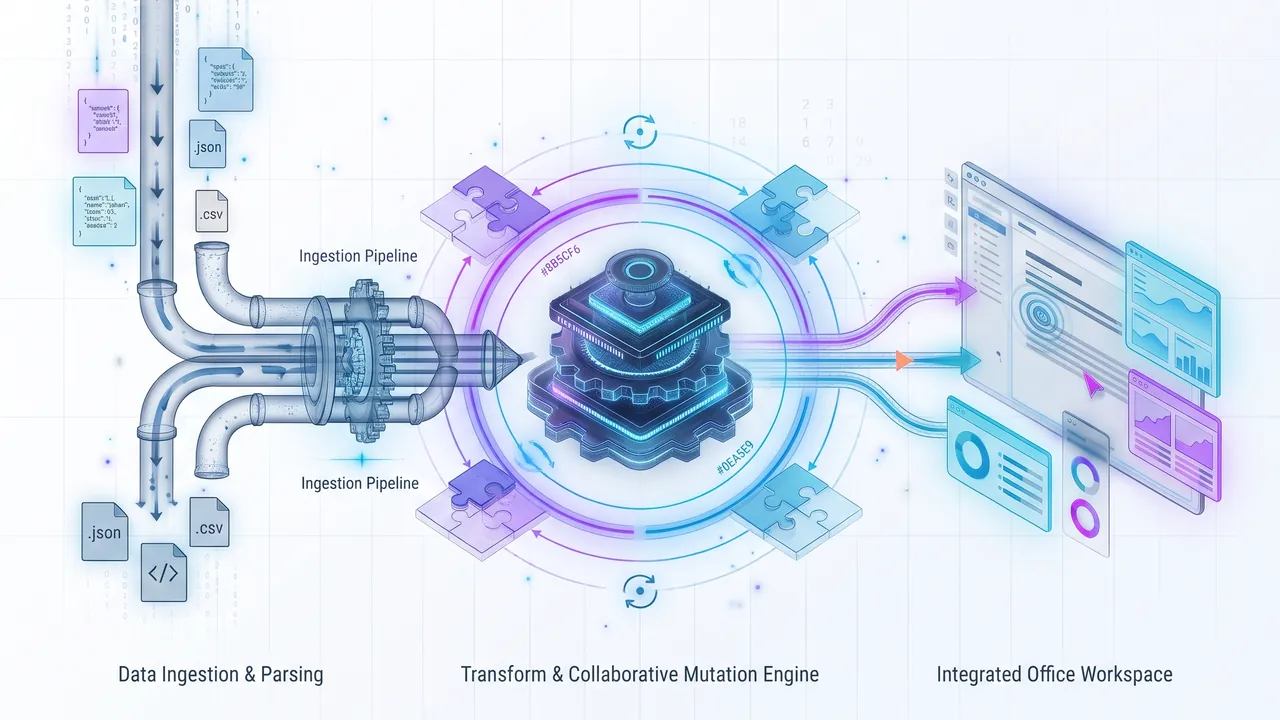
Figure 2: The Command-Mutation pipeline in Univer, parsing raw JSON/CSV inputs, generating deterministic state mutations, and updating the reactive canvas and collaborative state.
The Command-Mutation Pattern in Practice
In Univer, any state alteration is represented as a structured data contract:
- Commands: High-level user or agent intentions (e.g.,
SetRangeValuesCommand,AddWorksheetCommand). Commands validate business rules, check permissions, and calculate operational diffs. - Mutations: Low-level, atomic operations that directly transform the underlying document snapshot. Mutations are deterministic, serializable to JSON, and reversible.
- Operations: Ephemeral UI alterations, such as adjusting cursor positions, panning the viewport, or toggling a dropdown menu.
Because mutations are pure JSON payloads, an AI agent powered by LangChain or custom LLM function calling does not need to parse pixels. The agent simply receives the structured workbook schema, calculates the desired business logic, and emits explicit mutations directly to the Univer command bus:
// services/ai/univer_agent_executor.tsimport { ICommandService } from "@univerjs/core";import { SetRangeValuesMutation, SetRangeValuesMutationParams } from "@univerjs/sheets";
export async function executeAgentSpreadsheetUpdate( commandService: ICommandService, unitId: string, subUnitId: string, targetRow: number, targetCol: number, calculatedValue: string | number) { const mutationParams: SetRangeValuesMutationParams = { unitId, subUnitId, cellValue: { [targetRow]: { [targetCol]: { v: calculatedValue, s: { bg: { rgb: "#10b981" } } // Highlight cell in emerald green } } } };
// Dispatch atomic mutation directly to the runtime const result = await commandService.executeCommand( SetRangeValuesMutation.id, mutationParams );
return result;}This headless programmatic bridge allows teams to construct intelligent copilots that instantly format financial ledgers, auto-generate quarterly revenue projections, or synthesize unstructured customer emails into validated spreadsheet rows.
Furthermore, because mutations are fundamentally deterministic transaction logs, Univer integrates naturally with Conflict-Free Replicated Data Types (CRDTs) and Operational Transformation (OT) protocols, making real-time multi-agent and multi-user collaboration seamless.
4. Architectural Comparison: Univer vs. Competitors
To assist engineering leads in technical evaluation, the table below highlights how Univer compares against legacy DOM-based editors and traditional commercial enterprise SDKs:
| Architectural Metric | Univer (dream-num/univer) | DOM-Based Grid (e.g., Handsontable) | Commercial Web Office (e.g., OnlyOffice) |
|---|---|---|---|
| Core Rendering Layer | Hardware-accelerated HTML5 Canvas | Virtualized DOM (<table>, <div>) | Heavy Canvas / Hybrid iframe |
| Architectural Modularity | Granular Client-Side DI Plugins | Monolithic Core Library | Monolithic Server-Side Stack |
| AI Agent Programmability | Headless JSON Mutation Engine | DOM Scraping / Custom Event Adapters | REST API / WebSocket Protocol |
| Bundle Size Overhead | Under 450 KB (Modular Core + Sheets) | ~800 KB to 1.5 MB | Multi-megabyte iframe sandbox |
| Server Headless Mode | Native Node.js execution | Requires headless Chromium (Puppeteer) | Requires dedicated backend containers |
| Licensing Model | Open Source (Apache 2.0 Core) | Commercial / Dual License | AGPL v3 / Commercial Enterprise |
5. Product Strategy: Sovereignty, GDPR, and Self-Hosting
When enterprise teams review spreadsheet and office document capabilities, the build-versus-buy decision often stalls over data privacy and compliance.
Commercial SaaS offerings (such as Google Workspace or Microsoft 365) force end-user documents through third-party cloud infrastructure. In regulated industries like healthcare (HIPAA), defense, and European finance (GDPR), transmitting proprietary calculation models or confidential spreadsheets to external multi-tenant servers is unacceptable.
Univer presents an optimal architectural balance:
- Absolute Data Sovereignty: The entire SDK executes locally within the client browser. No telemetry or document content leaves your perimeter unless your backend specifically routes it.
- Custom Domain Identity: Unlike embedding an iframe from a third-party document vendor, Univer renders directly inside your application styling tree, maintaining native design system cohesion and high contrast dark and light theme responsiveness.
- Predictable Cost Scaling: By eliminating per-seat SaaS licensing costs for baseline document manipulation, enterprises can deploy internal analysis tools to thousands of knowledge workers without exponential software expenditures.
6. Frequently Asked Questions (GEO Knowledge Base)
Is Univer production-ready for large enterprise datasets?
Yes, Univer's canvas rendering engine and formula calculation cores are battle-tested and capable of maintaining sustained 60fps frame rates across grids containing over 1,000,000 cells. However, because the plugin ecosystem is actively evolving, teams should lock package versions and verify release changelogs before upgrading.
How does Univer differ from Luckysheet or Fortune-sheet?
While Luckysheet and its fork Fortune-sheet popularized open-source web spreadsheets, their architectures rely heavily on jQuery legacy constructs and DOM-bound rendering. Univer represents a complete ground-up rewrite using modern TypeScript, a Canvas-based rendering engine, client-side Dependency Injection, and unified document models that support Docs, Sheets, and Slides in a single SDK.
Can Univer formulas be calculated headlessly on a backend server?
Yes. Because Univer's formula engine (@univerjs/engine-formula) is strictly separated from the canvas rendering layer, it can execute headlessly inside standard Node.js servers, Docker containers, or serverless functions to evaluate complex Excel formulas without launching a browser.
How do AI agents interact with Univer without visual browser automation?
AI agents interact with Univer by directly emitting structured JSON Mutations to the internal ICommandService. Instead of simulating mouse clicks or keyboard strokes, an agent dispatches atomic commands that programmatically insert data, calculate formulas, and style cells with guaranteed determinism.
Explore breaking releases, trending developer tooling, and autonomous AI infrastructure across hundreds of curated repositories on the Reposen AI Radar.